


Milan Fashion Week SS27: Fashion Is Remembering What Brands Are For

For the past few seasons, fashion has been busy becoming everything at once: entertainment, internet culture, celebrity, spectacle, content. Milan Spring/Summer 2027 suggested a subtle correction.
Across the week, one question kept resurfacing: how does a fashion house evolve without losing the reason people cared about it in the first place?
From Gucci’s return to the customer to Bottega Veneta’s evolving identity and Armani’s careful transition into a new era, Milan made the case for something increasingly valuable in fashion: clarity.
Gucci Put the Store Back at the Center
Perhaps no show made fashion’s changing priorities more explicit than Gucci. Demna staged his Spring/Summer 2027 collection inside a replica of a Gucci store, complete with merchandise, sales associates and a VIP room. After seasons in which fashion shows increasingly competed to become entertainment properties, Gucci turned the retail environment itself into the spectacle.
The message was almost impossible to miss: eventually, someone has to buy the clothes.

Image: Gucci "The Store Show" Setting
But the more interesting story was one of brand identity. Over his first year at Gucci, Demna has moved through different interpretations of the house, from La Famiglia to GucciCore and Primavera. This season felt closer to consolidation. He described his Gucci through three characters — the aristocrat, the snob and the eccentric — bringing together equestrian codes, bourgeois wardrobes, glamour and the sharper cultural instincts that have always defined his own work.
That process matters beyond Gucci. When creative directors inherit houses with decades of cultural baggage, the temptation is often either to preserve the archive too literally or to overwrite it completely. Gucci is attempting something more difficult: identifying which parts of the brand are actually essential, then rebuilding around them. And crucially, doing so with the customer in mind.
The Store Show was designed around clothes for different types of Gucci consumers, turning the abstract question of brand identity into a very practical one: what should actually exist inside a Gucci store?
For brand managers, that may be Milan’s most relevant lesson. A strong brand identity cannot exist only in campaigns, moodboards or runway concepts. Eventually, it has to become product.
Images: Gucci, SS27
Bottega Veneta Showed That Evolution Doesn't Require Reinvention
At Bottega Veneta, Louise Trotter offered another version of the same conversation.
Her third collection for the house felt noticeably lighter. Tailoring relaxed, leather became almost weightless and crochet, straw and ribbons introduced something deliberately imperfect and human. Even intrecciato moved beyond a recognisable visual signature into a broader idea about craft and interconnectedness.
What made the collection interesting from a branding perspective was its restraint. Trotter didn't need to announce a “new Bottega.” Instead, she allowed her own point of view to gradually emerge through the existing language of the house. That distinction feels increasingly important.
Luxury has spent years treating the arrival of a new creative director almost like a rebrand: new logo, new campaigns, new casting, new visual universe, new everything. But constant transformation can eventually weaken the very equity brands are trying to monetise. Bottega suggested another model: evolution through interpretation rather than replacement. Identity doesn't have to remain static to remain recognisable.
Images: Bottega Veneta, SS27
Armani Is Facing Luxury's Hardest Branding Question
Nowhere was that question more significant than at Giorgio Armani. One year after Giorgio Armani's death, Silvana Armani presented Evoluzione, a collection built around the idea that style can change while remaining fundamentally itself. The clothes remained unmistakably Armani — fluid tailoring, elongated silhouettes, controlled elegance — but the language became more graphic and direct.
For a founder-led house, this is perhaps the ultimate brand-management challenge.
When the founder is the brand, what happens when the brand has to exist without them?
The immediate instinct is often preservation. But heritage brands cannot survive indefinitely as museums of their own greatest hits. The challenge is determining which codes are sacred, which can evolve and which should eventually be challenged. Armani's current strategy is one of careful movement rather than rupture. It works precisely because the transition is visible without feeling theatrical. But eventually, continuity will need to become momentum.
Images: Armani, SS27
Meanwhile, Fashion Got More Real
Beyond the major houses, another shift was happening across Milan.
Max Mara leaned into pragmatic clothes for actual women. Tod's focused on lived-in personal style. Ferragamo continued sharpening Maximilian Davis' increasingly recognisable vocabulary. Jil Sander's Simone Bellotti began disrupting the house's famous precision from within rather than rejecting it altogether. Even Prada built an entire collection around one of fashion's most ordinary garments: the skirt.
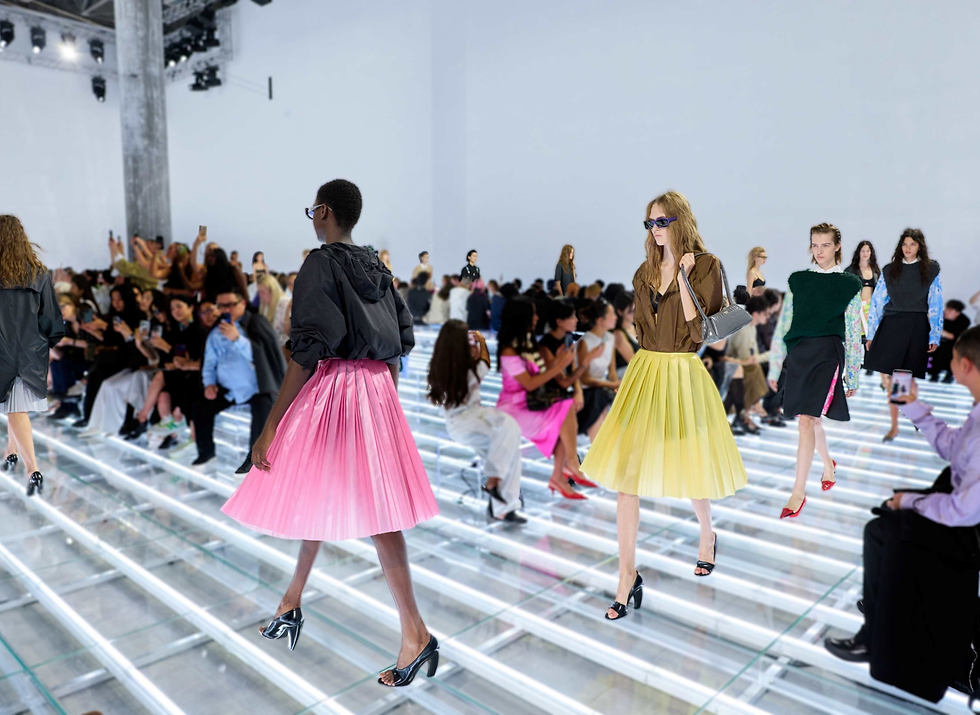
Image: Prada, SS27
After years of runways engineered for screenshots, Milan seemed increasingly interested in the relationship between clothes and the people who might actually wear them. This doesn't mean spectacle is disappearing. It means spectacle alone is becoming less convincing as a strategy.
Vogue World Turned Spectacle Into the Product
Vogue World Milan offered the interesting counterpoint. Staged inside the Galleria Vittorio Emanuele II, the event brought together fashion, dance, music, technology and some of the industry's most recognisable names under the theme The Human Touch in the Age of Technology.
But Vogue World is increasingly interesting for reasons beyond fashion. It is also a business model.
As traditional publishing economics become more difficult, Condé Nast is turning its editorial authority into experiences, memberships, sponsorship opportunities and global livestreamed entertainment. Vogue is no longer simply documenting fashion culture. It is increasingly producing it. That distinction matters. For decades, fashion media monetised access to the industry through magazines and advertising. Vogue World suggests the next version may be about monetising participation in the world the media brand has spent decades constructing.
In other words, brand equity itself becomes infrastructure.
Images: Vogue World, SS27
The Bigger Shift: From Attention Back to Meaning
There was still plenty designed to circulate online in Milan. There always will be. But this season felt less interested in asking How do we get people to look at us? and more interested in asking What should they understand when they do? That is a much harder question.
Attention can be bought, engineered or borrowed. Brand meaning takes longer to build. The strongest moments of Milan Fashion Week weren't necessarily the loudest ones. They were the moments when brands seemed unusually clear about their own role: Gucci confronting who its customer is, Bottega allowing identity to evolve, Armani protecting its essence while preparing for its future, and Vogue transforming cultural authority into an entirely new business proposition. Perhaps fashion isn't abandoning spectacle after all. It is simply remembering that spectacle works better when there is a strong brand underneath it.
And in a market where everyone is competing for the same increasingly fragmented attention, knowing exactly what your brand stands for may once again be fashion's greatest competitive advantage.


Comments