


When Desire Becomes Strategy: Milan FW26
- alizetuncel

- Mar 8
- 4 min read
No one announced it. No memo was sent. And yet, somewhere between the debuts, the sophomore shows and the front-row reshuffles, Milan collectively decided to bring desire back.
Yes, there were major creative transitions. Yes, the industry parsed every casting choice and every hemline in real time. But beneath the noise, something else was happening. Across houses with radically different identities, the body re-entered the frame.
So the real question is beyond who debuted, or who survived their second season. The question is: why did so many brands, at the same time, choose to lean into attraction?
Let’s unpack how Milan staged it.
The Ones Who Said It Out Loud
At Gucci, Demna made the intention explicit. “Clear and attractive and hot. I need fashion to be like that for me,” he said before the show, adding that he wanted to move away from over-intellectualising product.
On the runway, that translated into body-clinging silhouettes, ultra-mini dresses, sharply cut transparent gowns, and men’s tops sliced to expose the torso. The opening looks featured sculpted male physiques in tight proportions tailored specifically to their body types. The message was direct: proportion, presence, physicality.






Images: Gucci FW 2026/2027
At Dolce & Gabbana, the vocabulary was more familiar but equally intentional. Nearly every look revisited black lace, corsetry, sheer stockings, and the house’s signature red lip. This was not experimentation. It was the romantic Italian heritage amplified. Domenico and Stefano returned unapologetically to their Sicilian codes. Transparency, lace, lingerie silhouettes. The repetition itself was the statement.

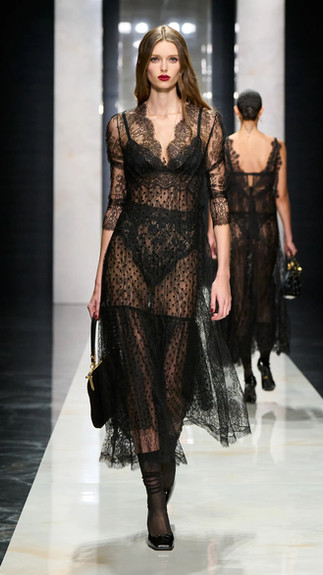


Images: Dolce & Gabbana FW 2026/2027
Diesel staged what Glenn Martens described as the aftermath of a night out. A kind of walk-of-shame morning, clothes thrown back on in haste. Twisted denim, peeling fabrics, boiled wool that looked heat-warped. The aesthetic suggested intimacy without polish. Even that dishevelled energy, however, was engineered.


Images: Diesel FW 2026
At Max Zara Sterck, black dominated. Wide openings, deep cuts, exposed torsos and sheer panels positioned the body as focal point rather than detail. There was little ambiguity. Attraction was structural.


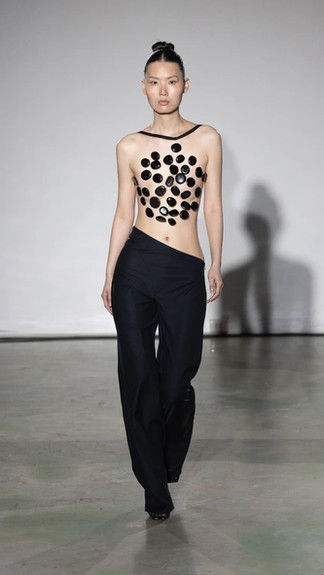


Images: Max Mara FW 2026/2027
These designers moved physicality from subtext to the forefront.
The Tailored Flirt
Other houses framed intimacy through construction.
At Fendi, Maria Grazia Chiuri approached the body through tailoring. Blazers layered over lace chemisier dresses, structured coats revealing sheer underlayers and of course, lace. The palette leaned black and neutral, heightening silhouette over spectacle. One industry observer described the result as “very Dior… but marinated in Roman sauce,” making the femininity feel more intimate, slightly more grounded. Chiuri herself insisted on pragmatism, stating she is “not an entertainment designer.” The sensual undercurrent existed, but it was disciplined.



Images: Fendi FW 2026
Etro created tension by placing rigid, almost severe jackets over open shirts and visible lace bralettes. Corsetry appeared beneath masculine forms. The dialogue between exterior control and interior exposure felt deliberate rather than decorative.


Images: Etro FW 2026
At Jil Sander, Simone Bellotti explored contradiction. Severe vertical tailoring collided with collapsing seams and curved cuts. Dresses battled their own construction. The sensuality was not overt. It emerged through proportion and tension.


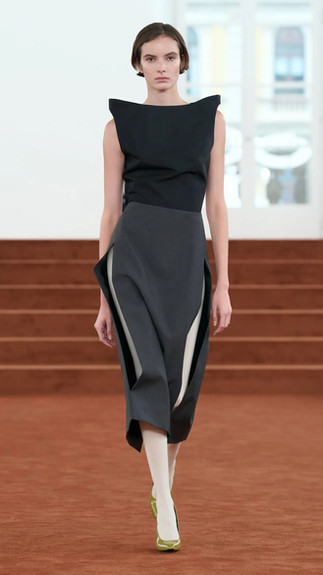
Images: Jil Sander FW 2026
In these collections, attraction was embedded in contrast rather than display.
The Almost-Bare Conversation
Before assuming this was simply a season of exposure, it is worth looking more carefully. In several collections, what appeared to be vulnerability was intentional.
At Prada, the undressing was literal and conceptual. Fifteen looks walked the runway four times, each iteration removing a layer. Miuccia Prada and Raf Simons framed it as a reflection on how we layer daily, socially, psychologically. This was not random transparency.
Yet within that intellectual structure, a softer register surfaced. Romantic, embroidered skirts appeared beneath utilitarian nylon tops. Sheer fabrics and delicate detailing introduced fragility into Prada’s typically pragmatic vocabulary. The tension between function and intimacy felt deliberate.


Images: Bella Hadid in Prada FW 2026
At Marni, under Meryll Rogge, fragility was not confined to outerwear reveals. Textured coats occasionally opened to expose contrasting layers, but the more telling moments appeared in elsewhere.
Chunky cardigans and structured knit pieces were layered over large paillette-covered, semi-transparent dresses and tops. In other instances, those same translucent, heavily embellished pieces appeared on their own, without the protective layer. Organza skirts with floral textures were worn without visible underlayers, letting the fabric itself carry the exposure.
The effect was awkward, slightly off-balance, deliberately tactile. Craft and vulnerability coexisted in the same silhouette.



Images: Marni FW 2026
Here, intimacy emerged through layering, texture and proportion.
The Conditions for Desire
Simultaneity at this scale demands explanation.
When houses with different creative histories, ownership structures and customer bases arrive at a similar emotional register, it suggests shared pressure points rather than shared styling references. Milan did not move in unison because of trend diffusion alone. It moved because multiple forces converged at once.
Start with structural exposure. Gucci’s revenues have reportedly declined from over €10 billion in 2022 to approximately €6 billion in 2025, with the brand representing roughly 40 percent of Kering’s group sales. In that context, creative direction is inseparable from commercial urgency. As Business of Fashion observed in its assessment of Gucci’s debut, the logic remains enduring: attraction drives attention, and attention drives product. This is not for Gucci only. In a cooling luxury cycle, brands cannot rely on coherence alone. They must restore appetite.
But financial recalibration is only one layer.
There is also aesthetic fatigue. The era of hyper-sanitised minimalism, beige refinement and algorithm-friendly “clean” beauty has saturated both luxury and mass markets. Even Demna openly expressed frustration with what he described as the beige, hydrated TikTok version of beauty. Neutrality, once disruptive, has become default. And default does not generate urgency.
Then there is the question of translation. Structured lace, engineered transparency and corsetry integrated into tailoring are not abstract runway experiments. They are adaptable, photographable and retail-friendly. They introduce intensity without destabilising production logic.
Finally, there is the psychological climate. In uncertain economic cycles, visibility functions as reassurance. Presence becomes performance. The foregrounded body reads as immediacy in a moment defined by digital abstraction and strategic ambiguity.
Fashion rarely moves in perfect synchrony. But when houses with radically different identities arrive at the same emotional register, it signals pressure beneath the surface. Milan did not simply show clothes this season. It recalibrated desire.


Comments